Pillar / Vertical Farming
Controlled food systems designed for resilience, efficiency, and long-term sustainability.
Vertical Farming is the food layer of the Foundation ecosystem: building controlled growing environments powered by technology, renewable energy, and intelligent system design to support food resilience, local production, and long-term sustainability.
The challenge
Food systems are under pressure from land, climate, and supply constraints.
Land availability, climate instability, supply chain disruption, and resource pressure are reshaping how food must be produced and distributed.
Traditional agriculture remains essential, but resilience now depends on complementary systems that can operate with greater control, consistency, and efficiency.
Purpose
Food production must become more controlled, efficient, and locally adaptable.
The aim is to develop vertical farming as a practical system for sustainable food production, capable of operating independently of traditional constraints such as land availability and seasonal variation.
This approach supports consistent yields, efficient resource use, and the ability to grow food closer to where it is needed.
The focus is not trend-led production, but building a reliable system that contributes to long-term food resilience.
Precision growing
Controlled environments help regulate light, temperature, humidity, and nutrient delivery with greater consistency.
Resource efficiency
Food production can become more measured, less wasteful, and less exposed to the pressures of land and seasonality.
Local resilience
Growing closer to communities helps shorten supply chains and strengthen more reliable access to fresh produce.
How it works
Controlled environments enable precision growing.
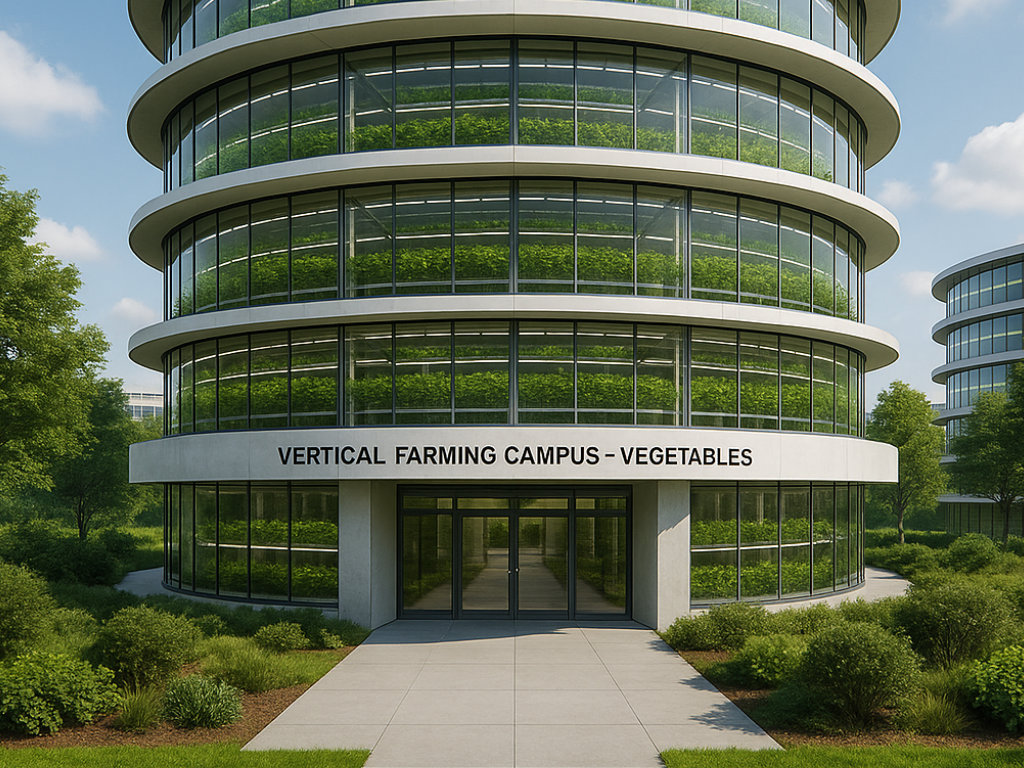
Vertical farming operates through fully controlled environments where light, temperature, humidity, and nutrient delivery are managed with precision.
This includes LED lighting systems, climate control, water irrigation, and monitored growing conditions that improve efficiency and reduce waste.
The result is a growing system that can operate consistently regardless of external environmental conditions.
Powered by innovation
Technology and engineering systems drive performance and reliability.
The Innovation Hub provides the underlying systems that make vertical farming viable at scale.
This includes energy systems such as solar generation and battery storage, alongside heating, ventilation, and environmental control infrastructure.
Data and analytics support monitoring, optimisation, and continuous improvement across all growing environments.
Energy systems
Solar generation, battery storage, and resilient infrastructure support more stable long-term operation.
Environmental control
Heating, ventilation, lighting, irrigation, and climate systems help create dependable growing conditions.
Data and optimisation
Monitoring and analytics improve performance, efficiency, and continuous refinement over time.
Farm to table
Production can move closer to communities and reduce dependency on long supply chains.
Controlled growing environments allow food to be produced closer to where it is consumed, reducing transport requirements and increasing freshness and reliability.
This supports a more direct farm-to-table model, where communities can access locally grown produce with greater transparency and consistency.
Shorter supply chains strengthen food security and reduce exposure to disruption.
Local production
Growing closer to communities helps improve freshness, visibility, and reliability.
Shorter supply chains
Less dependency on long transport routes and more resilience against disruption.
Food resilience
More stable access to controlled production can strengthen long-term food security.
Ecosystem role
Food systems connect with energy, innovation, and learning.
Vertical Farming is supported by the Innovation Hub through energy, infrastructure, and system design, while also contributing to learning, outreach, and practical demonstration within the Foundation.
This creates a connected model where food production is not isolated, but integrated into a wider system of knowledge, sustainability, and applied development.
Food production
Controlled growing helps create consistent outputs in a more stable and measurable environment.
Learning and outreach
The system can also act as a practical environment for education, demonstration, and wider public understanding.
Connected development
Vertical farming becomes stronger when integrated with innovation, energy systems, and the wider Foundation model.
Global expansion
Systems can be adapted to local regions, climates, and communities.
The model is designed to expand beyond a single location, adapting to regional climates, local food requirements, and community needs.
This allows knowledge, systems, and infrastructure to be shared across different environments while respecting local conditions and agricultural context.
Local communities can benefit through increased access to fresh produce, practical knowledge, and opportunities for economic growth.
Long-term focus
The aim is a scalable and reliable food production system.
Vertical Farming is being developed as a long-term component of the Foundation ecosystem, capable of evolving with technology and demand.
The focus is on building systems that remain efficient, adaptable, and capable of supporting food resilience over time.
A resilience commitment
Food resilience should be designed, not hoped for.
No fragile model. No wasted system. No dependence on chance alone.