Pillar / Innovation Hub
The intelligence, infrastructure, and systems engine behind the Foundation ecosystem.
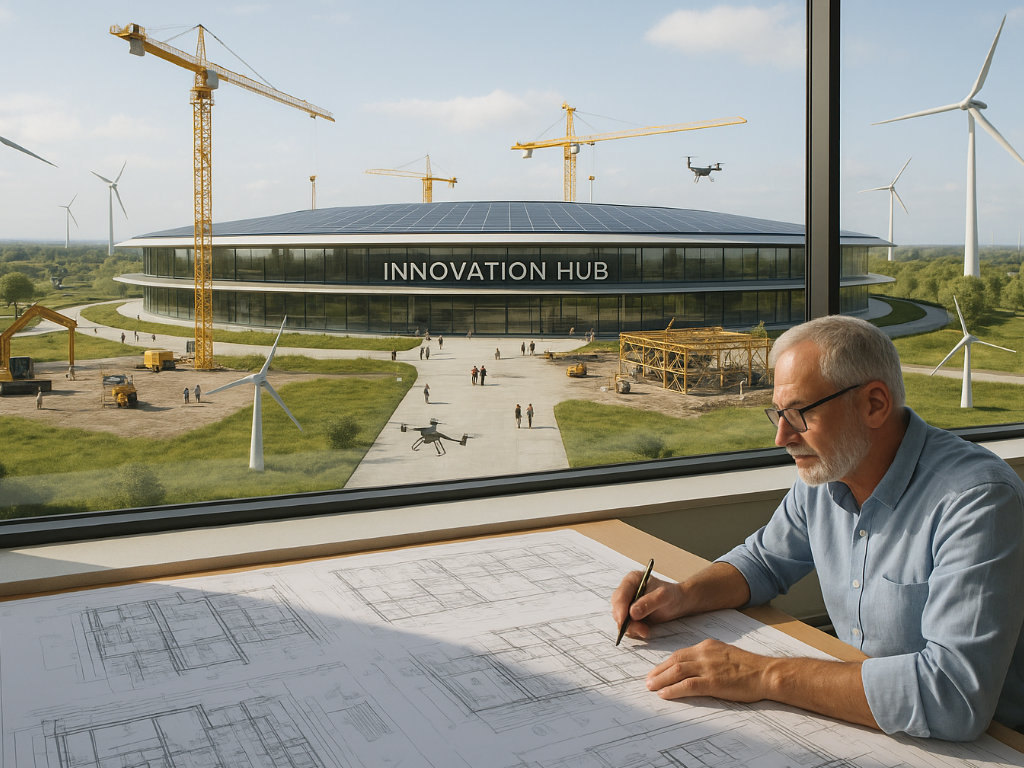
The Innovation Hub is the intelligence and infrastructure layer of the Foundation: supporting every other area through data, analytics, engineering, energy systems, and applied technologies that improve clarity, performance, and resilience.
The challenge
Innovation often fails when it is disconnected from real systems.
Many of the challenges facing land, food systems, animal welfare, and environmental resilience are already understood. The difficulty lies in building systems that can respond effectively and consistently over time.
Innovation is too often treated as novelty or isolated experimentation, rather than as a disciplined process for improving real-world outcomes.
Role within the ecosystem
This is the system that supports and strengthens everything else.
The Innovation Hub operates as the central intelligence layer of the Foundation, supporting all other areas through data, analytics, engineering, and applied technologies.
It provides the tools, systems, and infrastructure needed to improve decision-making, increase efficiency, and ensure that each part of the ecosystem can operate with greater clarity and capability.
Its purpose is not to exist separately from the wider model, but to strengthen the performance and resilience of the whole.
Data and analytics
Monitoring, insight, and decision support across land, welfare, food systems, and operations.
Engineering systems
Practical technical infrastructure that improves performance, reliability, and resilience over time.
Applied development
Building and refining tools, platforms, and systems that can be tested, used, and improved in real conditions.
Featured build
A revenue generator for the ecosystem.
HEADTURNED PPV is being designed as a serious digital platform that helps generate revenue for the wider Foundation ecosystem.
It turns technology, product design, and infrastructure into a practical funding mechanism that can help support restoration, animal welfare, innovation, and long-term public value.
HEADTURNED PPV
Flagship platform build designed to generate revenue and strengthen the Foundation’s long-term capability.
What it does
Work is focused on applied systems, not abstract ideas.
Development is grounded in practical problem-solving, where ideas are tested against real conditions and refined through use.
This includes building and improving systems across data collection, analysis, monitoring, automation, and operational performance.
The focus is on creating solutions that can be implemented, measured, and improved over time, rather than concepts that remain theoretical.
Data and analytics
Better decisions depend on better information.
Data and analytics provide the foundation for understanding what is working, what is not, and where improvements can be made.
This includes monitoring animal welfare, tracking environmental conditions, supporting agricultural systems, and improving operational efficiency across the ecosystem.
Insight becomes a practical tool for decision-making, rather than an afterthought.
Data science
Structuring, analysing, and interpreting complex information to improve system decisions and measurable outcomes.
Smart data
Turning raw inputs into usable signals, monitoring, and operational intelligence across the ecosystem.
Robotics and drone tech
Supporting inspection, monitoring, automation, surveying, and data capture where technical reach improves clarity and efficiency.
AI and AI tooling
Practical intelligent tools that help with analysis, pattern recognition, support systems, and operational productivity.
Machine learning
Models and learning systems that improve forecasting, automation, detection, and decision support over time.
Energy and infrastructure
Resilient systems require independent and sustainable infrastructure.
Renewable energy systems, including solar generation, battery storage, heating, and ventilation, form a core part of the Hub’s practical role.
These systems provide the foundation for energy resilience across the ecosystem, reducing dependency and enabling more stable long-term operation.
This infrastructure is especially important for areas such as vertical farming, where controlled environments depend on reliable and efficient resource systems.
Solar and storage
Independent energy support for long-term operational resilience.
Climate systems
Heating, ventilation, and environmental control where stable conditions matter most.
Operational reliability
Infrastructure that keeps systems running with greater consistency and control.
Control environments
Stable, engineered settings that support specialised systems such as food production and technical operations.
Systems resilience
Infrastructure planning that helps the wider ecosystem adapt, continue, and perform under pressure.
Supporting the wider ecosystem
Every part of the Foundation becomes stronger through integrated systems.
Conservation is strengthened through monitoring and environmental data. The Animal Sanctuary is supported through welfare analytics, diagnostics, and medical capability. Vertical Farming is enabled through controlled systems, energy infrastructure, and resource management.
Media and Learning & Careers are equally important, helping make knowledge, processes, visibility, development, and participation more structured, usable, and transferable across the wider ecosystem.
This creates a connected model where improvements in one area can inform and strengthen the others.
Conservation
Environmental monitoring, ecological data, and stronger long-term insight into restoration conditions and land performance.
Animal Sanctuary
Welfare analytics, diagnostics, treatment support, and systems that improve care quality and operational clarity.
Vertical Farming
Energy, environmental control, climate systems, and efficiency-focused infrastructure for controlled production.
Media
Systems that help capture, organise, present, and distribute information so the wider ecosystem can be seen, understood, and supported more clearly.
Learning & Careers
Tools, platforms, and practical systems that help turn knowledge, participation, and real-world work into structured development pathways.
Experimentation and development
Progress comes from disciplined testing and refinement.
New approaches are developed through structured experimentation, prototype thinking, and continuous iteration.
The focus remains on usefulness and applicability, ensuring that development leads to measurable improvements rather than isolated exploration.
Long-term focus
The aim is to build capability that improves over time.
The Innovation Hub is designed to be a lasting part of the Foundation’s structure, supporting growth, adaptation, and long-term resilience.
Its role is to ensure that the ecosystem continues to evolve with clarity, intelligence, and practical capability, rather than remaining static.
A systems commitment
Capability should compound, not stall.
No isolated thinking. No static infrastructure. No drift from practical usefulness.